
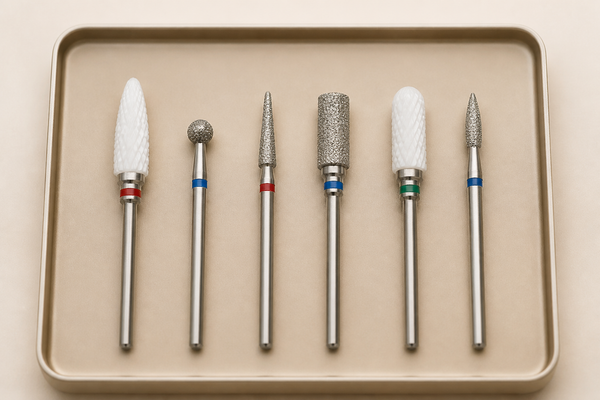
An e-file bit should be selected for a specific material, location and movement, not because its shape looks familiar. The same flame, cone or barrel may be sold in different materials and abrasive grades, and colour bands are not interpreted identically by every manufacturer. Safe work begins with the exact product specification, training and a clear view of the contact zone. Speed never compensates for the wrong bit, excessive pressure or poor control.

Read material and abrasive grade before shape
Diamond bits carry abrasive particles on a metal body and are commonly used for precise dry preparation around non-living cuticle tissue or for refining a surface, depending on grit and training. Carbide and ceramic bits cut product with flutes and are generally selected for reducing cured enhancement material, not for casually filing the natural nail or living skin.
Shape describes access, not automatic purpose. A slim flame can reach a lateral pocket when the operator has correct visibility. A small ball can refine already lifted non-living tissue. A rounded or safety barrel can reduce product over a broader area. Every use still depends on grit, flute direction, diameter and the manufacturer’s instructions.
Stop on pain, burning, bleeding, damaged skin, unusual nail changes or poor visibility. Rotating instruments can remove material quickly and require formal practical training. This guide supports product selection but cannot replace supervised technique education.
Common bit families and practical tasks
- Flame and needle profiles: narrow access around folds; require a stable angle and exact tissue recognition.
- Ball profiles: finishing already lifted non-living tissue, never pushing blindly into a fold.
- Cone and tapered profiles: controlled access or refinement according to material and grit.
- Barrel profiles: reduction and shaping of cured product; rounded safety ends reduce, but do not remove, the need for control.
- Mandrel and sanding band: interchangeable abrasive system; use a fresh band per client and choose grit for the task.

Match shape to access and movement
Start with the task: removing bulk builder product, refining a cured surface, cleaning non-living tissue or smoothing a transition. Then confirm the substrate. A bit suitable for hard gel may be too aggressive for a thin base layer, and a fine diamond bit intended for dry cuticle work is inefficient for removing bulk product.
Check whether the bit is right- or left-handed, one-directional or suitable for both directions. Inspect it before every use for bending, corrosion, damaged coating or clogged flutes. Secure it fully in a compatible handpiece and never operate a bit that vibrates.
- Use the narrowest shape that provides visibility without entering blind spaces.
- Select abrasive grade from the maker’s specification, not band colour alone.
- Keep the working surface moving and avoid staying on one point.
- Adjust speed to bit diameter, material and trained technique.
- Change to a manual method whenever control or visibility is limited.
Control direction, pressure and heat
Pressure and dwell time generate heat. The bit should do the work with light contact and continuous movement. If the client feels warmth, stop immediately, reassess speed, pressure, bit condition and product thickness. Cooling a painful area and continuing without correction is not a solution.
Direction affects control. Work so the rotation does not pull the bit into the fold or off the free edge. Reverse mode is used only with bits and technique designed for it. Practise on training material before working close to skin or a natural nail.
- Confirm bit, handpiece and rotation compatibility.
- Test for vibration before touching the nail.
- Stabilise the finger and maintain a supported hand position.
- Use light contact and continuous, visible passes.
- Stop at the first heat, pain or loss of control.

Common e-file mistakes
- Choosing by shape alone: material and abrasive grade can completely change the action.
- Using colour bands as a universal code: confirm each manufacturer’s legend.
- Filing living skin: a clean contour never justifies injury.
- High pressure at low movement: increases heat and creates grooves.
- Reusing disposable sanding bands: compromises hygiene and cutting consistency.
- Skipping bit processing: cleaning and the required disinfection or sterilisation process must match the tool and local rules.
Know when a non-rotary method is better
A rotating tool is not obligatory for every service. Cuticle Remover can soften excess cuticle for gentle manual preparation when its label and the client’s skin allow. Remove every residue before coating.
For a verified soak-off coating, controlled acetone removal may reduce the need to file close to the natural plate. Open the surface only as instructed, soak until the material softens and never pry resistant product. Hard gel and other file-off systems require a different removal plan.
Clean reusable bits immediately after service so debris does not dry in the flutes. Process them using products, contact times and equipment appropriate to the material and local salon regulations. Store processed bits dry and protected.
E-file bit checklist
- Exact material, grit and direction are confirmed.
- Bit is straight, clean, intact and fully seated.
- Task and substrate match the manufacturer’s use.
- Operator has visibility, support and trained control.
- Heat, pain or vibration triggers an immediate stop.
- Disposable and reusable items follow the correct hygiene cycle.
Preparation and compatible removal alternatives
Browse nail tools and accessories. For a gentle non-rotary preparation option see Cuticle Remover, and for removal of a confirmed soak-off system review Acetone 500 ml. Choose the method that preserves control and follow every product instruction.
The best e-file bit is not the fastest one. It is the bit whose material, abrasive grade, shape and direction fit one defined task in trained hands. Verify the specification, keep pressure light, control heat and change methods whenever visibility or safety is reduced.